
What is Dyslexia?
Dyslexia affects people in different ways. Each person has their own individual pattern of strengths and challenges.
No two people with dyslexia are the same.
Possible strengths of a dyslexic learner
Dyslexic thinking often comes with real strengths. These show up differently for every child.

Visualising
Thinking in pictures, visualising ideas and seeing concepts from different perspectives.

Connecting
Making connections between ideas, understanding others and seeing the bigger picture.

Exploring
Being curious, exploring ideas and approaching problems in different ways.

Imagining
Thinking creatively, generating original ideas and finding new ways of doing things.

Communicating
Expressing ideas, telling stories and creating clear and engaging messages.
Dyslexic thinking skills
Possible challenges for a dyslexic learner
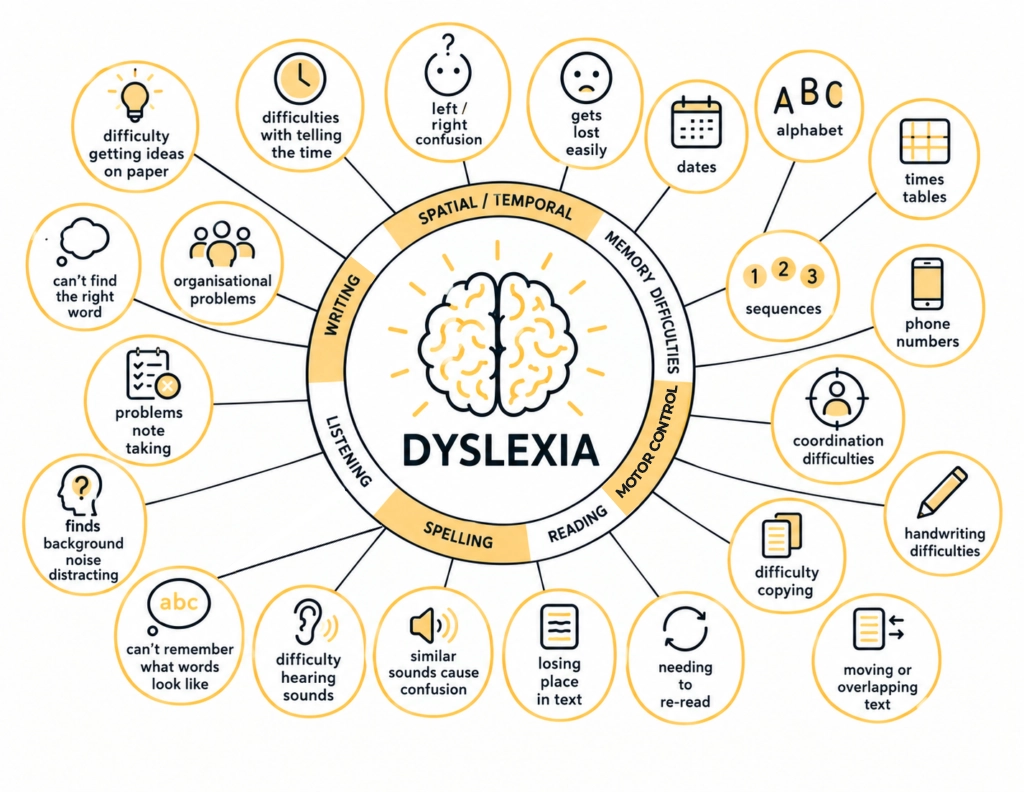
Dyslexia can affect literacy, memory, organisation and processing in many combinations. The map below shows some of the areas it can touch.
Dyslexics see things differently!
Just as every person is unique, dyslexia presents differently from one individual to another. This can make dyslexia difficult to define, and a number of different definitions are used worldwide.
In the UK, the British Dyslexia Association (BDA) has adopted the Delphi Definition of Dyslexia (2025).
Nature
The nature and developmental trajectory of dyslexia depend on multiple genetic and environmental influences.
Manifestation
Dyslexia is a set of processing difficulties that affect the acquisition of reading and spelling. The most commonly observed cognitive impairment in dyslexia is a difficulty in phonological processing (i.e. in phonological awareness, phonological processing speed or phonological memory). However, phonological difficulties do not fully explain the variability that is observed. Working memory, processing speed and orthographic skills can contribute to the impact of dyslexia.
Impact
In dyslexia, some or all aspects of literacy attainment are weak in relation to age, standard teaching and instruction, and level of other attainments. Across languages and age groups, difficulties in reading fluency and spelling are a key marker of dyslexia.
Variance and Co-occurrence
Dyslexic difficulties exist on a continuum and can be experienced to various degrees of severity. Dyslexia can affect the acquisition of other skills, such as mathematics, reading comprehension or learning another language. Dyslexia frequently co-occurs with one or more other developmental difficulties, including developmental language disorder, dyscalculia, ADHD, and developmental coordination disorder.
Different ways of thinking can bring real value to society. People with dyslexia may bring distinctive strengths, perspectives and approaches. Watch this video to learn more about the contribution of dyslexic thinking in the workplace.
Frequently asked questions
Some people experience visual stress when reading, where text may appear to move, blur or become distorted. Coloured overlays or tinted lenses may help some individuals, although evidence of their effectiveness is mixed. Visual stress is separate from dyslexia and should not be used as an indicator of dyslexia.
Some children develop strategies that help them compensate for their difficulties, meaning that signs of dyslexia may not become apparent until they are older. As the demands of the curriculum increase, these strategies may become less effective and previously hidden difficulties can become more noticeable.
Dyslexia is not an illness, so there is no ‘cure’. It is a lifelong difference that primarily affects reading and spelling, but can also impact areas such as writing, memory, processing speed and organisation. With appropriate teaching, strategies and support, people with dyslexia can develop their skills, understand how they learn best and build on their individual strengths.
Wondering if this sounds like your child?
Get in touch for an initial conversation. We can talk through what you are noticing and consider the best way forward.
Arrange a conversationGet in touch for an initial conversation
We can talk through your concerns and consider the best way forward for your child.
Arrange a conversation